

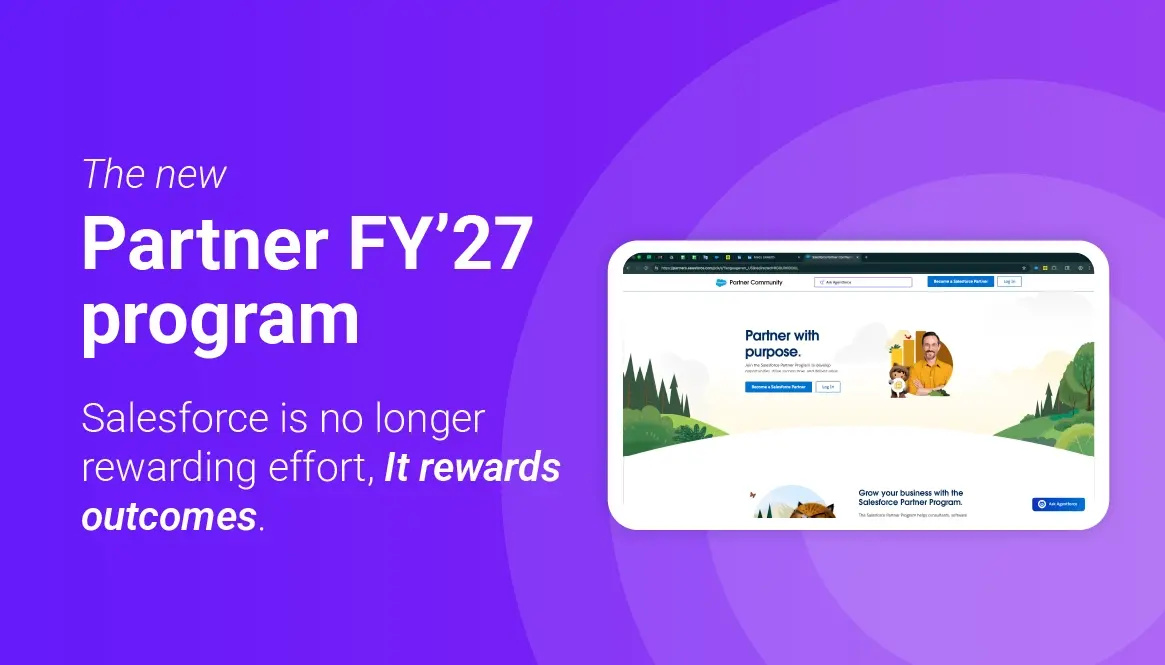
Salesforce FY’27 Partner Model: What’s Changing & Why
Introduction
Salesforce has rolled out updates to its FY27 Partner Program, and, it looks like a structured shift. New tiers, AI focus, lifecycle incentives. All of that sounds expected given where the ecosystem is heading.
But if you step away from the announcement language and look at this as someone who works closely with Salesforce environments, the intent becomes much clearer.
This is not just Salesforce refining its partner ecosystem. It is Salesforce correcting how the platform has been used for years. And honestly, it was needed.
What Has Changed
At a high level, the changes revolve around three things:
- Strong push toward AI (Agentforce 360)
- Clearer partner tiers (Summit and Select)
- Incentives tied to long-term value, not just delivery
None of this is surprising. What matters is why this direction is being pushed now?
For a long time, the ecosystem has been heavily implementation-driven. Businesses would invest in Salesforce, partners would deliver the setup, and once the system went live, the focus would gradually fade.
The assumption was simple: “If the system is built, it will be used.”
In reality, that’s where most problems start.
Where Most Salesforce Setups Actually Struggle
From what we’ve seen across different clients, the issue is rarely the platform itself. Salesforce is flexible enough to support almost any business model.
The problem is what happens after implementation.
- The system is configured based on initial requirements
- Teams start using it, but with variations
- New processes are introduced without updating the system
- Data starts becoming inconsistent
- Reports slowly stop reflecting reality
Nothing “breaks.” But the system starts losing trust. And once that happens, adoption drops quietly. This is the gap the new partner program is trying to address.
The AI Push: Necessary, But Slightly Misplaced (For Now)
Salesforce is clearly betting big on AI through Agentforce 360. From a product perspective, that makes complete sense. The future of CRM is not just storing data, but helping businesses act on it.
But here’s the practical concern.
Most businesses are still dealing with:
- Incomplete or inconsistent data
- Low user adoption
- Misaligned workflows
- Over-customized systems
In such environments, AI does not create efficiency. It simply accelerates confusion. So while the AI push is directionally right, it also exposes a bigger reality:
AI will only be valuable for businesses that have already fixed their foundations.
And that’s where the role of a partner becomes more critical than ever.
Specialization: A Much-Needed Shift
One of the more meaningful changes in the FY27 program is the focus on competencies and specialization. This is a good move, because one of the biggest issues in the ecosystem today is the “we do everything” approach.
In practice, that often leads to:
- Over-engineered systems
- Generic implementations
- Lack of clarity in design decisions
A partner who deeply understands:
- A specific cloud
- A specific industry
- Or a specific use case
will always deliver better outcomes than someone trying to cover everything. From a business perspective, this changes how you should evaluate partners.
Instead of asking: “Can they implement Salesforce?”
You should be asking: “Have they solved problems similar to ours before?”
Lifecycle Incentives: Probably the Most Important Change
This is where Salesforce got it right, the shift toward lifecycle-based incentives is not just a program update. It’s an acknowledgment of how Salesforce actually works in real environments.
Because the truth is:
Salesforce is not a one-time project. It is an ongoing system.
What happens after go-live matters more than what happens during implementation.
Without ongoing alignment:
- Processes drift
- Data quality drops
- Reports lose reliability
- Teams start working outside the system
And over time, the business ends up with a CRM that exists, but is not fully trusted.
By incentivizing partners on:
- Adoption
- Performance
- Long-term value
Salesforce is essentially pushing the ecosystem toward continuous engagement. That’s a positive change.
Will This Improve Salesforce Efficiency?
Short answer: Yes. But only under one condition. Businesses also need to change how they approach Salesforce.
If companies continue to treat Salesforce as:
- A one-time investment
- A static system
- Or just a reporting tool
then even the best partner model won’t help.
Efficiency will improve when:
- Systems are reviewed regularly
- Changes are structured, not reactive
- Data is treated as a priority, not an afterthought
- There is clear ownership of the CRM
In other words, the program can guide direction. But execution still depends on how seriously businesses take their systems.
What Businesses Should Do Now
This update is a good opportunity to pause and evaluate your current setup.
Not from a technical perspective, but from a practical one.
Ask yourself:
- Does our Salesforce reflect how our business actually operates today?
- Are our reports reliable enough for decision-making?
- Do we have a clear ownership model for managing the system?
- Are we building toward future capabilities like AI, or still fixing basics?
If any of these answers are unclear, it’s a signal that your system needs attention.
Our Perspective as a Salesforce Partner
From where we stand, this shift aligns closely with what we see on the ground. Most businesses don’t need more features. They need better alignment. Most systems don’t fail during implementation. They lose effectiveness over time.
And most of the value in Salesforce is not created at go-live. It is created in how the system is maintained, improved, and adapted. The FY27 Partner Program is essentially pushing the ecosystem in that direction.
Final Thought
This is not just a partner update. It’s a reset in expectations.
- From building systems → to making them work continuously
- From delivering projects → to driving outcomes
- From static setups → to evolving platforms
The real question is no longer “Do we have Salesforce implemented?” It is “Is our Salesforce actually working for us?” If you’re currently using Salesforce and not fully confident about how well it’s performing, this is the right time to evaluate it properly. At The Pinq Clouds, we work with businesses to:
- Review existing Salesforce setups
- Identify inefficiencies and hidden gaps
- Structure systems for long-term performance and scalability
You can explore how we approach implementations, integrations, and managed support here: https://thepinqclouds.com/ Or reach out directly if you want a practical review of your current system before scaling further.