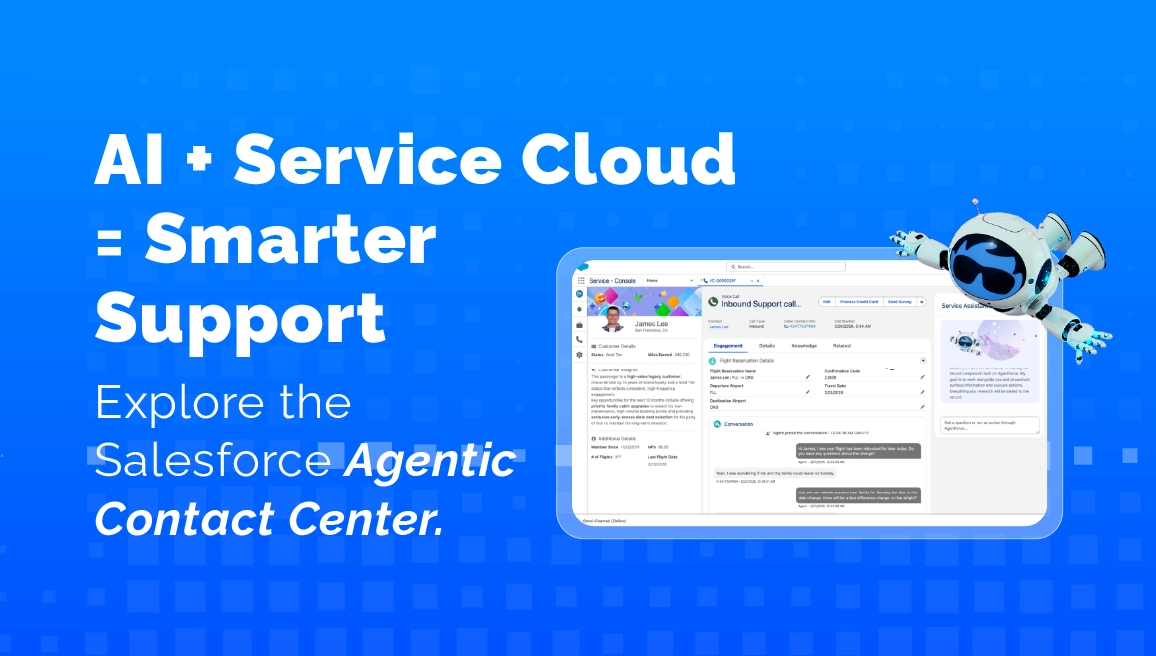
What is Salesforce Agentic Contact Center?
What is Salesforce Agentic Contact Center? The question usually comes up when organizations start exploring how AI can participate in customer support, not just assist it.
Support teams today deal with a mix of problems. Customers expect faster responses, service teams handle more channels than ever, and agents are switching between systems all day. CRM, order systems, knowledge bases, messaging apps. Sometimes five or six screens open at once.
At first the conversation around AI in service was about automation. Chatbots answering simple questions. Ticket routing. Maybe knowledge suggestions.
Agentic service systems represent a different idea. Instead of only assisting agents, the system itself can take action inside workflows. That is the shift.
Understanding the Salesforce Agentic Contact Center
A Salesforce Agentic Contact Center combines AI agents, automation, and Salesforce service data to allow AI systems to act within service operations, not just respond nor act.
Traditional contact centers depend almost entirely on human agents. Even when AI tools are present, they mostly assist by suggesting answers or pulling information.
An agentic model goes further. An AI agent can interpret a request, gather data from Salesforce, trigger actions across connected systems, and move the case forward without waiting for a human to drive every step.
Sometimes a human still steps in, often they should, but the system does not sit idle while waiting. Think of it as a digital team member working alongside the service staff. The concept feels abstract until you see how it plays out in a real service environment.
A customer opens a chat asking about a delayed shipment. In a traditional setup the service agent receives the message, checks the order in Salesforce, reviews shipping status in another system, then replies to the customer. That whole process might take several minutes.
An agentic contact center behaves differently. The AI agent reads the request, identifies the order, checks the shipping integration, and determines whether the delay is known. If it is, the system can respond immediately with updated delivery details.
If the situation requires escalation, the AI agent passes the conversation to a human along with context.
- Order number.
- Shipment status.
- Prior interactions.
The human agent starts halfway through the process rather than from the beginning.
Why Service Teams Are Paying Attention
Many service leaders started exploring agentic systems because of a simple reality “Support volume keeps growing”.
Every new digital channel increases the number of customer conversations. Chat, email, messaging apps, community portals. None of them replaced phone support. They just added more work.
Service teams try to scale by hiring more agents and that approach eventually hits a limit as training takes time. Turnover is high in many support environments, and knowledge management becomes difficult when agents depend on multiple internal systems.
Agentic service models attempt to reduce the amount of repetitive work that agents handle manually.
- Checking order status.
- Updating case fields.
- Sending basic responses.
- Scheduling follow ups.
None of those tasks require complex judgment, but they consume time throughout the day. AI agents can handle many of them automatically. That leaves human agents focusing on the situations where empathy, negotiation, or decision making matter more.
How Salesforce Supports Agentic Service
Salesforce has been gradually building pieces that support this model and Salesforce Service Cloud already manages case data, customer history, and communication channels. Over time the platform added automation layers like Flow, AI capabilities like Einstein, and integration tools connecting external systems.
Agentic service builds on top of those foundations. Agentforce and related AI capabilities allow AI agents to access Salesforce data, understand service context, and execute actions within defined boundaries.
Those boundaries are important.
Most organizations do not want AI making unrestricted decisions inside customer service workflows. Instead the system operates within guardrails designed by service architects.
For example an AI agent may be allowed to:
- Retrieve order status
- Update a case field
- Send a templated response
- Trigger a refund approval workflow
But not finalize a refund without human confirmation. Control still matters. The goal is not replacing agents but to reduce friction inside the support process.
Where Teams Usually Run Into Challenges
Implementing an agentic contact center is not just a technology decision. It changes how service operations function. Many organizations underestimate the preparation required.
AI agents rely heavily on structured data and clear workflows. If customer records are inconsistent or knowledge articles are outdated, the system struggles to respond accurately.
This happens more often than people expect. One service organization discovered their case data contained five different fields representing the same product category. Human agents understood the differences. The AI system did not.
- Cleaning up that data became part of the implementation.
- Another challenge involves trust.
Agents sometimes worry that AI systems will replace their roles. Service leaders usually need to explain that the goal is to remove repetitive tasks, not eliminate human interaction. Once agents see the system reducing manual work, the resistance tends to fade.
What the Customer Experience Looks Like
From the customer’s perspective the change is subtle: “Responses arrive faster”.
Basic questions receive immediate answers. Order updates, appointment confirmations, subscription changes. All handled quickly.
When a human agent joins the conversation, the interaction already contains useful context. The agent does not ask the customer to repeat information that the system already knows. Customers rarely care whether the first response came from AI or a human. They care about resolution. Agentic service models try to improve that outcome.
Key Insights
- Agentic contact centers allow AI systems to act within service workflows rather than only suggesting responses
- Human agents remain involved, especially when judgment or empathy is required
- Data quality and workflow design strongly influence how well AI agents perform
- The approach reduces repetitive tasks that consume large portions of agent time
What Companies Should Consider Next
Organizations exploring Salesforce agentic service capabilities should begin by reviewing their existing service architecture. Look at the processes that consume the most agent time. Many of them involve predictable steps like:
- Retrieving information.
- Updating records.
- Sending status updates.
Those are potential candidates for agentic automation.
Next evaluate the quality of service data. AI systems depend on clear structures and consistent records. If the data model is messy, the AI will struggle.
Finally start small. A single service workflow often provides enough insight to understand how AI agents interact with real customer conversations. Once teams gain confidence in the system, additional processes can gradually move into the agentic model.
Closing Reflection
Customer service has always depended on human judgment, and that part is not changing. What is changing is the amount of manual coordination required to solve a problem. Switching between systems, collecting context, updating records. Tasks that slow agents down.
Agentic contact centers remove some of that friction. The interesting part is not that AI participates in service workflows. The interesting part is how quickly support teams start wondering how they ever handled the workload without it. Wanna see how it can change your service team productivity? Contact us today at contact@thepinqclouds.com or visit our website www.thepinqclouds.com