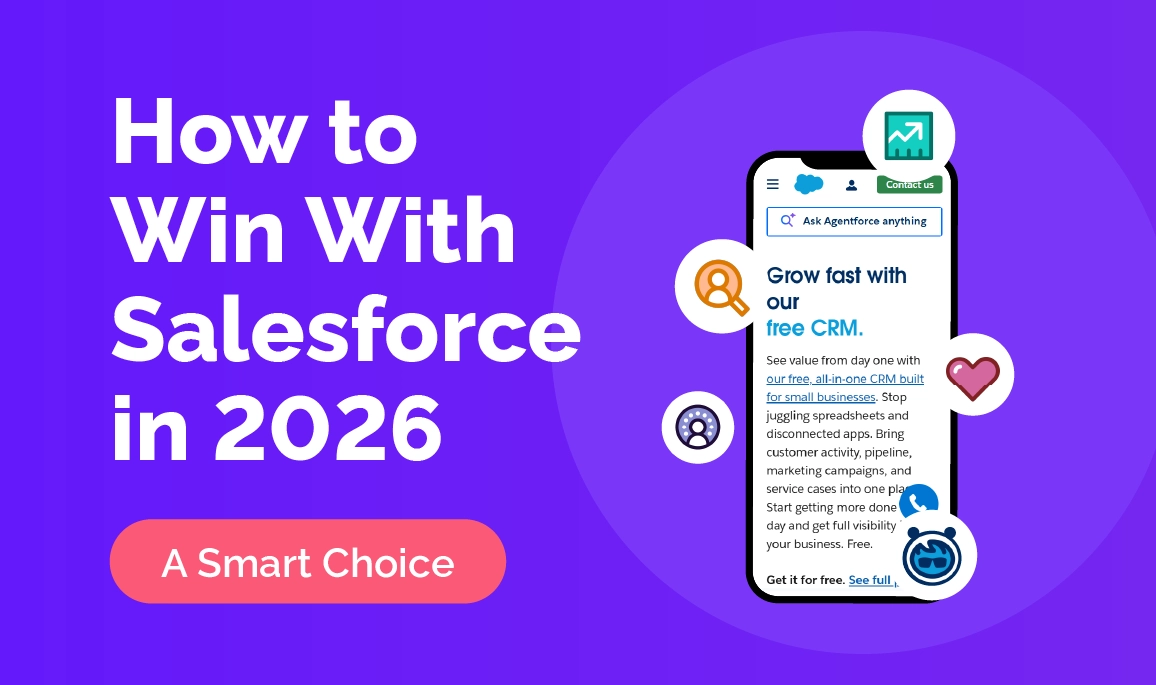
How to Win With Salesforce in 2026: A Smart Choice
Introduction
How to win with Salesforce in 2026 isn’t about buying more clouds, enabling more licenses, or chasing every shiny AI release. It’s about alignment. Between business goals and CRM strategy. Between internal teams and external partners. And—this part is often overlooked—between ambition and execution reality.
We’ve sat in enough kickoff meetings to recognize the pattern. Big expectations. Aggressive timelines. Someone says, “Salesforce should fix this.” And everyone nods, even though no one’s fully agreed on what this actually is yet.
That gap? That’s where Salesforce success is either built—or quietly compromised.
So let’s talk about what actually works in 2026, especially if you’re a growing business or a consulting partner trying to guide one.
Salesforce Success in 2026 Starts With Strategy, Not Setup
Here’s the uncomfortable truth: Salesforce itself is rarely the problem.
By 2026, Salesforce has matured into an ecosystem—Sales Cloud, Service Cloud, Marketing Cloud, Data Cloud, Agentforce, AI layers, automation everywhere. The platform is powerful. Almost too powerful if you don’t slow down and decide what matters first.
And this is where many teams stumble.
They jump straight into configuration before answering three basic questions:
- What business outcome are we optimizing for?
- Who owns Salesforce internally?
- How much change can the organization realistically absorb?
We’ve learned the hard way that clarity early on saves months later. Sometimes entire quarters.
Winning with Salesforce in 2026 means resisting the urge to “turn everything on.” Instead, it’s about sequencing. Build trust in the system first. Adoption follows trust, not features.
How to Win With Salesforce in 2026 Using the Right Partner Model
This is where the partner conversation gets interesting—and, honestly, where many decisions are made too quickly.
Not every company needs the same type of Salesforce partner. And yes, let’s be honest—not every Salesforce project needs a full consulting army either.
Consulting Partner vs Managed Services (And Why It Matters)
1. A Salesforce Consulting Partner is typically your go-to when:
- You’re implementing Salesforce for the first time
- You’re re-architecting an existing org
- You’re launching a complex transformation (Data Cloud, AI, CPQ, multi-cloud)
2. A Salesforce Managed Services Partner makes more sense when:
- Salesforce is already live
- You need ongoing enhancements, support, and optimization
- Internal teams are stretched thin
One client once told me they avoided managed services because it felt “outsourced.” But that perception changed fast when their internal team stopped firefighting and started planning again.
Here’s the kicker: in 2026, the most successful companies use both—just at different stages.
A Real-World Story: When Salesforce Looked “Done” (But Wasn’t)
A retail client once realized mid-project that their Salesforce rollout looked complete on paper—but sales teams were still using spreadsheets. Quietly. Religiously.
Nothing was technically broken. Dashboards worked. Automations fired. But the CRM didn’t match how reps actually sold.
We paused. Re-ran discovery. Simplified flows. Removed features instead of adding more.
And that’s when adoption finally clicked.
We’ve seen this before—the moment the CRM breaks flow, teams lose trust. And once trust is gone, no amount of AI or automation fixes it.
Winning with Salesforce in 2026 means designing with users, not for them.
Key Takeaways for Salesforce Success in 2026
If you remember nothing else, remember this:
- Start with outcomes, not objects
Salesforce should serve the business, not the other way around. - Choose partners by phase, not brand name
Big logos don’t guarantee the right fit for your current stage. - Adoption beats customization every time
A simpler system that people use will outperform a perfect one they don’t. - AI works only on clean foundations
No data strategy? AI will amplify the mess. - Ongoing optimization is non-negotiable
Salesforce is never “done.” And that’s okay.
Why This Matters for Businesses and Consulting Partners
For business leaders, Salesforce in 2026 is no longer just a CRM—it’s operational infrastructure. Sales forecasting, service efficiency, marketing attribution, AI-driven insights… they all run through it.
If Salesforce underperforms, teams feel it daily.
For consulting partners, the stakes are just as high. Clients aren’t impressed by certifications anymore. They want outcomes. Faster decisions. Cleaner handovers. Fewer surprises.
And if you’re advising clients? You’re not just implementing software. You’re shaping how the business operates for the next 3–5 years. That responsibility deserves more than a templated delivery approach.
What Companies Should Do Next (Practical, Not Theoretical)
So what now?
Here’s what we’d advise if we were sitting in a workshop together:
- Audit before you add
Review what’s live. What’s used. What’s ignored. - Define a 12-month Salesforce roadmap
Not a feature list—a business roadmap tied to KPIs. - Decide on your partner mix
Project consulting for big moves. Managed services for continuity. - Invest in enablement, not just builds
Training, documentation, and internal ownership matter more than most admit. - Plan for AI, but earn it
Data Cloud, Agentforce, predictive insights—great tools. But only after the basics work.
If you want a deeper dive on integration strategy, you can also read our internal guide on Salesforce integration best practices at The Pinq Clouds.
For official platform direction, Salesforce’s own perspective on AI and CRM evolution is worth reviewing on Salesforce.com’s product and innovation blog.
Conversational Closing (Because This Is Real Life)
Salesforce success in 2026 isn’t about perfection. It’s about momentum.
The companies that win are the ones that make Salesforce boringly reliable—then quietly powerful over time. No drama. No heroics. Just steady, intentional progress.
At The Pinq Clouds, we help organizations turn Salesforce strategy into measurable impact—whether that’s through focused consulting, reliable managed services, or simply asking the hard questions early.
And trust us, those early questions are where the real wins begin.