Salesforce Nonprofit Cloud vs NPSP: Choosing the Right Path for Your Mission
Introduction
If you’ve ever sat in a nonprofit strategy meeting where technology becomes the unexpected villain, you’ll understand why Salesforce Nonprofit Cloud vs NPSP is such a common debate. Someone says, “We need better fundraising visibility,” another says, “Our programs team can’t track outcomes,” and before you know it… the CRM becomes the center of the universe.
And honestly? I’ve watched teams overthink this decision until they’re exhausted — even though the difference becomes clearer once you strip away the jargon.
So let’s break it down like we would in a client workshop: candidly, with context, and with the real trade-offs nonprofits actually feel day-to-day.
Understanding Salesforce Nonprofit Cloud vs NPSP
Salesforce gives nonprofits two major routes:
- NPSP (Nonprofit Success Pack) — a flexible, open-source, highly customizable data model built on core Sales Cloud.
- Nonprofit Cloud (New Industry Cloud) — redesigned from the ground up, with a modern data model and built-in experiences for fundraising, programs, case management, and outcomes.
Now, on paper, both sound great. But here’s the kicker: they were built for two completely different eras of nonprofit transformation.
1. NPSP — Built for Customization and Cost Efficiency
NPSP is like a well-loved backpack. It has pockets for everything — households, donations, recurring gifts — and you can add patches (apps and customizations) over time.
Nonprofits love it because:
- It’s free to install.
- It works beautifully for fundraising-centric organizations.
- It has a massive community and ecosystem behind it.
- Admins can shape it endlessly — sometimes too endlessly.
But let’s be honest: NPSP still sits on Sales Cloud architecture, which means program management, case workflows, volunteer coordination… all require builder-level creativity or additional paid apps.
2. Nonprofit Cloud — Built for Today’s Integrated Mission Delivery
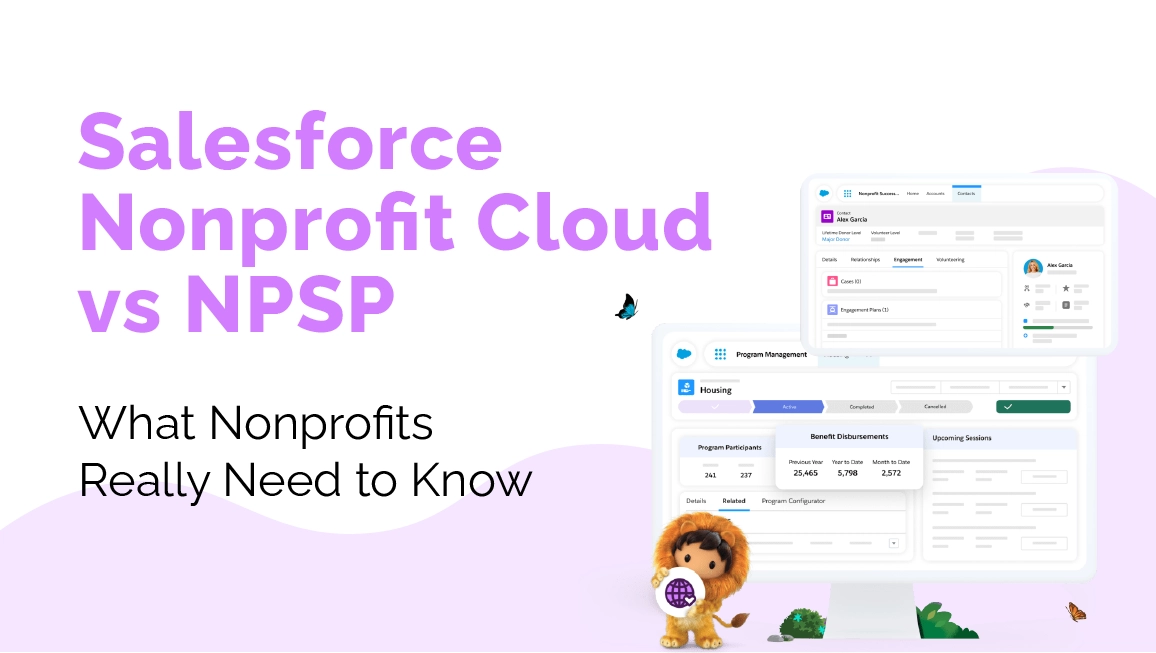
The new Nonprofit Cloud is Salesforce’s rethink of what nonprofits actually need now: unified engagement, program lifecycle, outcomes tracking, and service delivery — all on one data model.
Think of it as a purpose-built operating system for nonprofits who’ve outgrown “fundraising only” tools.
It includes:
- Program management designed for real-world delivery (not spreadsheets).
- Case management tied directly to constituent records.
- Outcome measurement frameworks.
- Fundraising reimagined on the same foundation.
And here’s where the cognitive drift kicks in — halfway into explaining this, I always remember a COO once saying: “I don’t want four systems talking to each other. I want one place where truth lives.” That’s essentially Nonprofit Cloud’s selling point.
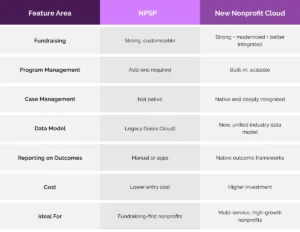
Quick Comparison — Salesforce Nonprofit Cloud vs NPSP
Here’s the simplified consultant version — the one we sketch during workshops when everyone nods a bit too politely:
A Story from the Field (Because Real Life Doesn’t Follow Data Sheets)
A mid-sized nonprofit once invited us to review why their Salesforce implementation felt “stuck.” Their fundraising team adored Salesforce NPSP — easy gifts, campaigns, major donor tracking. Smooth sailing.
But their program team? A different story.
They were juggling spreadsheets, Google Forms, and a legacy case management tool held together with… well, optimism. Every month, someone manually stitched data into reports for the board. And trust me, I’ve seen that look — the “we’re running on caffeine and hope” face.
Halfway through our discovery workshop, it became painfully clear:
- They didn’t have a fundraising problem.
- They had a mission tracking problem.
NPSP wasn’t the issue — but it also wasn’t designed to be their operations backbone.
When they switched to Nonprofit Cloud, something clicked. Suddenly, program enrollments, service delivery, impact reporting, fundraising, and constituent history all lived in one place.
They didn’t need a bigger team. They just needed the right architecture.
Key Takeaways
- NPSP is great if fundraising is your primary focus, and your programs are relatively simple.
- Nonprofit Cloud is better for nonprofits running multiple services, managing cases, or proving outcomes to funders.
- Cost shouldn’t be the only factor, but it will influence the decision — NPSP has a lower barrier to entry.
- The data model matters more than people expect. Future scalability depends on it.
- You don’t have to migrate immediately — many nonprofits operate happily on NPSP for years.
Why This Decision Matters for Nonprofits
Choosing between Salesforce Nonprofit Cloud vs NPSP isn’t a software debate. It’s a strategy debate — one that affects:
- Operational efficiency
- Reporting credibility with funders
- Staff adoption and burnout
- Long-term ROI on Salesforce investments
- Your ability to scale programs without breaking your CRM
And honestly, the number of nonprofits We’ve seen choose a system only based on price… and then pay twice that in workflow band-aids? It’s a pattern. A very avoidable one.
This choice determines whether your CRM becomes a growth engine or another system everyone quietly complains about.
What Nonprofits Should Do Next
If you’re still unsure which path fits, here’s the consultant playbook:
- Map your top five operational pains — fundraising, reporting, programs, service delivery, outcomes.
- Check which model naturally supports them, not which can be customized to support them.
- Evaluate staff capacity. Heavy customization can overwhelm small teams.
- Plan for 3–5 years, not the next 6 months.
- Do a guided fit assessment with a certified Salesforce partner.
And if We’re being blunt — clarity upfront saves months later. We’ve learned that the hard way across dozens of nonprofit projects.
Wrap Up
Choosing between Salesforce Nonprofit Cloud vs NPSP doesn’t need to feel like a high-stakes maze. When you look at your mission, your data realities, and your team’s workflow, the right path becomes surprisingly clear.
At The Pinq Clouds, we help nonprofits turn Salesforce strategy into measurable impact — without the overwhelm Whenever you’re ready, we can walk you through a practical, no-jargon assessment.