How Agentforce Fulfills Industry-Specific Business Needs
Introduction
Agentforce is changing how companies approach AI inside Salesforce—but not in the loud, disruptive way most people expect.
More often than not, the conversation starts quietly. A leadership team wonders if AI can remove friction somewhere. Not everywhere. Just somewhere useful. And then the doubts creep in. The data isn’t perfect. The processes are different by team. Compliance is non-negotiable. And nobody wants a tool that creates more cleanup than value.
That’s where Agentforce lands differently.
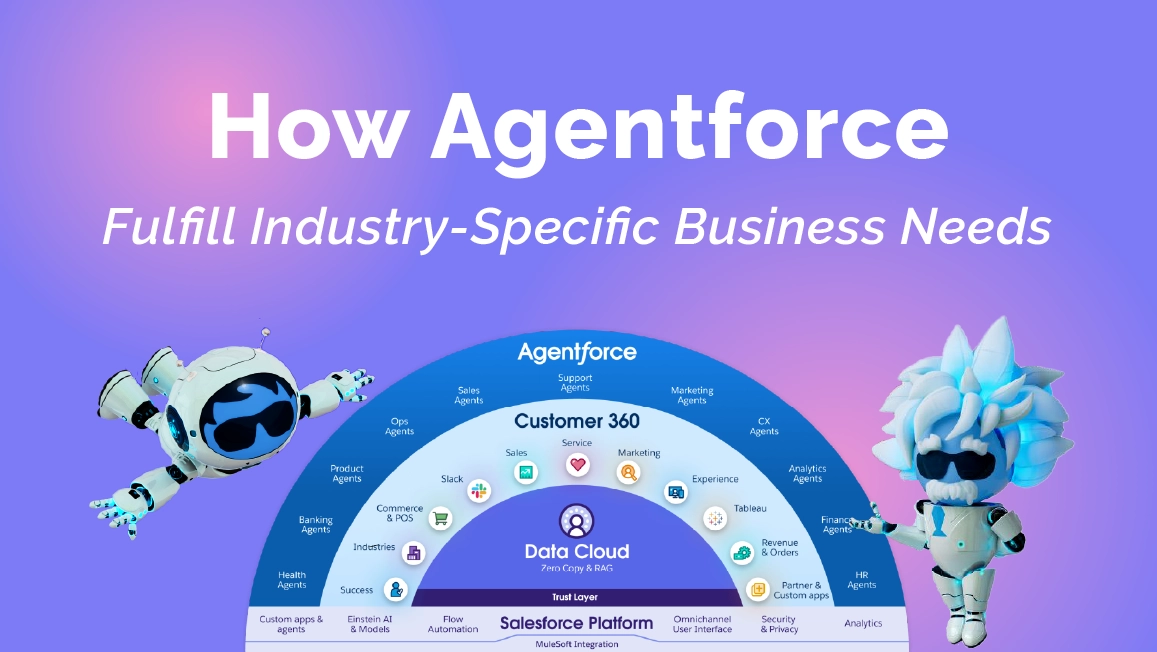
Built natively on the Salesforce platform—Data Cloud, Customer 360, the full ecosystem—Agentforce isn’t trying to be a one-size-fits-all intelligence layer. It’s built to work inside real industries, real roles, and real constraints. Financial services. Healthcare. Retail. Nonprofits. The environments where nuance matters.
Let’s slow down and look at how that actually plays out.
Agentforce and Industry Context (Where Most AI Falls Short)
At its core, Agentforce is a set of autonomous AI agents that operate using your Salesforce data, your industry models, and your business rules.
And that last part tends to get underestimated.
Most generic AI tools operate in abstraction. Agentforce doesn’t. It’s built on Salesforce Industry Clouds, which means it inherits industry-specific data models, predefined roles, and workflows shaped by years of real operational use.
In practical terms, that means:
- Agents reason with industry-aware context, not guesswork
- Actions stay within clearly defined boundaries
- Sensitive data remains protected through built-in guardrails
- Tasks can escalate smoothly to humans when judgment is required
That hesitation is reasonable—especially in regulated environments. But in practice, Agentforce is far more controlled than people expect. Permissions are explicit. Privacy rules are enforced. The agent knows when it’s allowed to act and when it needs to step back.
That balance is what makes adoption possible.
How Agentforce Learns From Your Business (Not the Internet)
Agentforce becomes effective when it’s grounded in your business data. It operates using three building blocks:
- Topics – what the agent is responsible for
- Actions – what it’s allowed to do
- Instructions – how it should behave, respond, and escalate
Salesforce provides industry-aligned starting points, which helps teams avoid a blank slate. But the real shift happens when organizations layer in their own workflows or connect Agentforce to Salesforce Data 360 Cloud.
This is often where conversations slow down—not because the technology is unclear, but because teams want reassurance they won’t lose control.
They don’t.
Instead, agents begin to:
- Handle repetitive prep work quietly in the background
- Support customers outside business hours without sounding scripted
- Reduce internal handoffs that drain time and energy
- Improve consistency while preserving flexibility
We’ve learned the hard way that AI without context doesn’t save time—it just moves the work somewhere else. Agentforce avoids that by staying anchored in how teams already operate.
Where This Shows Up Clearly: Real Industry Examples
Abstract explanations only go so far. A few grounded examples make the difference clearer.
1. Financial Services: Preparing for Client Meetings
For many advisors, meeting preparation eats into the day more than the meeting itself. Pulling recent interactions, reviewing account activity, and stitching together context takes time—and rarely adds strategic value.
With Agentforce, an AI agent prepares a concise briefing by pulling relevant data across Salesforce. Advisors still lead the conversation. The agent simply removes the background noise. The relationship stays human. The prep gets lighter.
2. Nonprofits: Making Donor Engagement More Personal
In practice, donor proposals are rarely “just a document.” They’re a mix of context, history, and timing—stitched together while the clock is already running.
Agentforce helps by pulling together donor history, engagement notes, and relevant insights into a draft proposal that gift officers can refine. What changes isn’t the message—it’s the time pressure.
One nonprofit leader put it simply: “We finally stopped rushing the thinking part.”
When AI Stops Feeling Experimental
And this is often the point where things begin to change.
AI stops feeling like a side experiment and starts behaving more like part of the team. Not making decisions. Not replacing people. Just handling the groundwork so humans can focus on judgment, trust, and nuance.
A healthcare team gets a clear summary instead of raw data.
A retail lead sees exceptions instead of spreadsheets.
A nonprofit officer gets breathing room instead of deadlines stacked on deadlines.
That’s the shift.
A Few Things Worth Noting
- Agentforce is designed for industries, not generic use cases
- Industry data models improve accuracy and relevance
- Guardrails are foundational, especially for regulated sectors
- Automation supports teams—it doesn’t sideline them
- Value compounds as agents learn real workflows
Why This Matters for Business Leaders and Partners
For decision-makers, this isn’t about “doing AI.” It’s about outcomes that matter:
- Better efficiency without operational disruption
- More return from existing Salesforce investments
- Support that scales without scaling headcount
- Trust that holds up under regulatory scrutiny
For consulting partners, Agentforce shifts the conversation. Less time spent configuring tools. More time spent aligning on outcomes—what should improve, what should move faster, and what should feel easier six months from now.
What Companies Should Do Next
If you’re considering Agentforce, it helps to resist going big on day one. Small, well-defined wins build momentum faster than ambitious rollouts.
A practical approach:
- Start with one friction-heavy process
- Be clear about boundaries and escalation paths
- Use Salesforce’s industry libraries as a foundation
- Introduce real workflows gradually
- Measure impact before expanding scope
Strong data foundations matter here. Teams that invest early in clean integrations move faster later.
For hands-on learning and official guidance, Salesforce Trailhead’s Agentforce resources are a solid place to explore what’s realistic before building.
Wrap Up
Agentforce doesn’t transform organizations overnight. And that’s a good thing.
It works quietly—inside existing workflows—helping teams stop chasing information and start using it. That’s often where the real value shows up.
At The Pinq Clouds, we help organizations turn Salesforce strategy into measurable impact. If you’re curious how this could work inside your own Salesforce org, feel free to reach out. A short conversation is often enough to decide whether it’s worth exploring further.