Salesforce Consulting Partner vs Managed Service Provider — Smart Choice Guide
Introduction
Should you turn to a Salesforce consulting partner or a Salesforce managed service provider (MSP) when planning your next CRM initiative (or ongoing support)? That’s the question I often hear from marketing leaders, and here’s the kicker: there’s no one-size-fits-all answer. Each serves a different purpose — and choosing the “wrong” one can mean wasted budget, stalled projects, or underutilized Salesforce potential.
(Yes — I’ve seen clients bring in the “wrong” kind of partner and scramble later to patch gaps. Let’s spare you that stress.)
In this post, I’ll walk you through the trade-offs, practical examples, and clear guidance. By the end, you’ll see which route makes sense — and when.
What Are These Two Models, Really?
1. Salesforce Consulting Partner (Implementation / Project-Focused)
A consulting partner (also called a “consulting / implementation partner”) is geared toward discrete projects: implementations, migrations, feature rollouts, or transformations. They specialize in architecture, requirements, development, integrations, change management, training — all scoped in phases.
Salesforce describes its partner ecosystem this way: “System Integrators or Consulting Partners … help you build, configure, implement, or optimize your Salesforce environment.”.
These firms often work under fixed or time-and-materials contracts, with a defined beginning, milestones, and an expected deliverable (e.g. “go-live with Sales Cloud + CPQ + Marketing Cloud integration”).
2. Salesforce Managed Service Provider (Ongoing Support & Optimization)
An MSP, by contrast, is more about “keep the lights on, improve, evolve”. After implementation, MSPs provide sustained support: bug fixes, minor enhancements, performance monitoring, org housekeeping, upgrades, governance, and sometimes strategic advisory.
Salesforce’s MSP program is built precisely for this post-implementation continuity — they step in after the major project is done. (partners.salesforce.com).
In practice, you’re buying a retainer or ticket-based access to a team that becomes part of your “extended team,” helping ensure Salesforce delivers value over time.
When to Engage a Consulting Partner vs an MSP (with Examples)
Let me share a quick story:
A mid-sized B2B SaaS company wanted to unify their lead capture flows (Marketing Cloud → Sales Cloud) and bring in custom quoting. They hired a consulting partner to execute the project: build new flows, data model, training, integration.
After go-live, daily support demands, small tweaks, and performance fixes piled up. They tried handing it over internally, but it became chaotic. Eventually they signed up with an MSP to manage the backlog, monitor health, and keep optimizing.
So: consulting partner for the project, MSP for the sustained run.
Here’s a quick side-by-side:
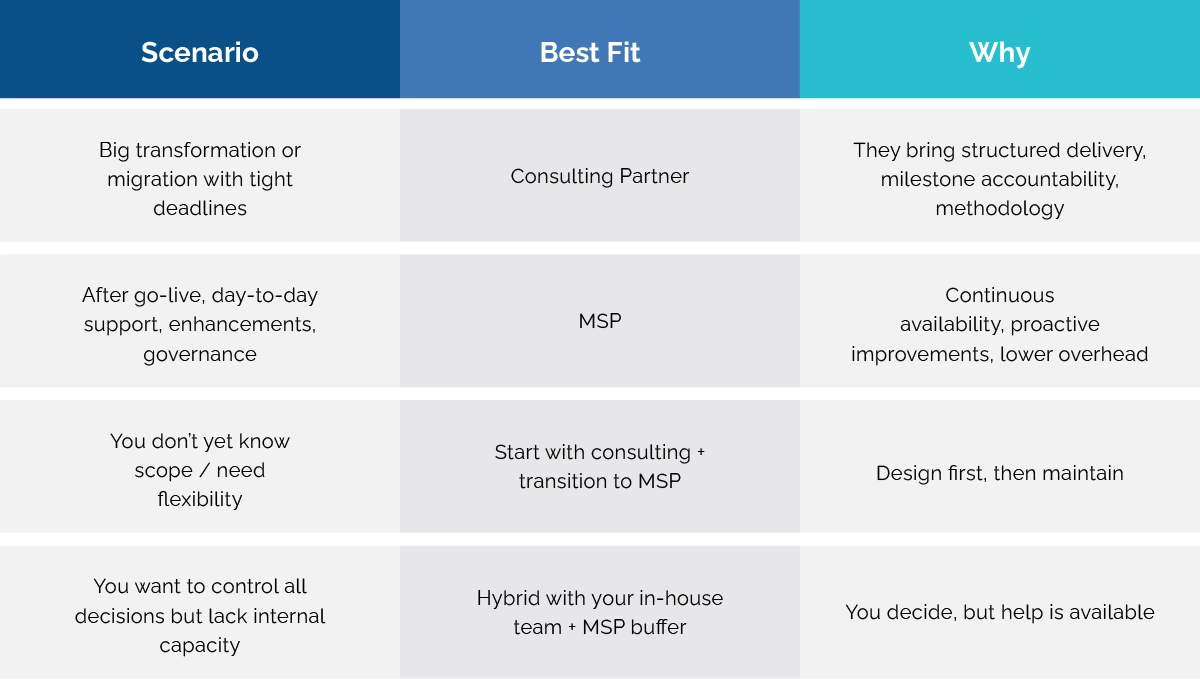
Let’s be honest: some smaller clients try to do everything with one partner, but they often face scope creep, unclear handoffs, or a partner that’s “good” at one but weak at the other.
Why This Matters for Businesses / Consulting Partners
Here’s why the choice really affects results:
- Budget & predictability: A consulting project can balloon if poorly scoped. An MSP retainer gives you predictable monthly costs (though scope creep is still a risk).
- Continuity & knowledge retention: With an MSP, you avoid knowledge loss when the consulting team “leaves.” MSPs tend to maintain institutional memory.
- Proactivity vs reactivity: Consulting partners are great at build, but many stop when the project ends. MSPs should continue to detect issues, recommend improvements, and keep your org healthy.
- Scaling & flexibility: As your business evolves, you’ll need new integrations, more users, possibly new clouds. MSPs are better built to scale and adapt.
- Risk mitigation: Bugs, broken automations, system outages — you want someone ready to resolve. MSPs with SLAs help contain risk.
For consulting partners themselves, this matters in how you package your offerings. Are you going to hand off after delivery, or stay (and get recurring revenue)? One feeds the other.
What Companies Should Do Next
If you’re weighing your own decision, here’s a roadmap:
- Map your phases
- Discovery & design → implementation → stabilization → operations & evolution.
- Use consulting help for phase 1–2. Bring in MSP for phase 3–4.
2. Define clear deliverables & SLAs
- For consulting work: milestones, acceptance criteria, support period post-go-live.
- For MSP: response times, scope boundary (e.g. small enhancements vs large redesigns), escalation path.
3. Select partners with complementary skills
- Choose consulting firms strong in delivery.
- Choose MSPs experienced in your stack (integration, data, industry).
- Ask for client references that show long-term engagements, not just one-off builds.
4. Plan the handoff early
- Ensure documentation, runbooks, logging.
- Overlap consulting & MSP in final weeks so knowledge is transferred and you avoid ‘orphaned’ systems.
5. Build governance and regular reviews
- Quarterly health checks.
- Roadmap alignment.
- Metrics: system uptime, defect resolution, enhancement backlog.
6. Budget for both
- Implementation cost is upfront.
- MSP cost is ongoing (often 10–20%+ of your Salesforce license or per-user costs, depending on complexity).
Consulting Partner vs Managed Service Provider: Which One Should You Prioritize?
If you’re asking “which do I contact first?”:
- Start conversations with consulting partners to scope your project.
- Ask them whether they also offer ongoing services or how handoff would work.
- Simultaneously evaluate MSPs (or the consulting partner’s MSP arm) — because post-launch is coming.
You’re not picking one “instead of” the other so much as choosing when to shift.
Key Takeaways (in Practice)
- Consulting partners excel in project delivery, structure, and execution.
- MSPs add value through continuity, optimization, and governance.
- Many clients need both — one after the other (or overlapping).
- Scope, budget, support expectations must be explicit.
- The strongest partner arrangements often combine implementation + managed services continuity.
What Companies Should Do Next
- Conduct a needs audit: what demands will your Salesforce org face in the next 12–24 months?
- List non-negotiables — e.g. must-have integrations, uptime, internal staffing limits.
Reach out to 2–3 consulting partners and 2–3 MSPs, asking for case studies and long-term engagement stories. - Draft a handoff plan: even if you hire one firm, identify how they will maintain knowledge or provide transition.
- Start small: pilot one module or area, see how the partner handles support, then expand.
Wrapping Up
In closing — you don’t have to choose “Consulting partner vs MSP” as an either/or forever. It’s more about timing, clarity, and alignment. Start with the design + build, then plan for operations and optimization. When done right, the combination becomes a trusted growth engine rather than a handoff risk.
At The Pinq Clouds, we help clients not only implement Salesforce but also build ‘living’ systems — ones that evolve with your business. If you’d like help scoping or navigating options, just say the word.
Every smart Salesforce story starts with the right partner. Let’s start yours, one step at a time.